1. B Field Outer Stator Analyzer
This analyzer determines the normal and tangential magnetic fields created in the airgap of an inner rotor, outer stator electric machine due to stator winding excitation.
1.1. Model Background
Typically, normal \(B_\text{n}\) and tangential \(B_\text{tan}\) fields created in the airgap of an electric machine are analytically determined using the following equations:
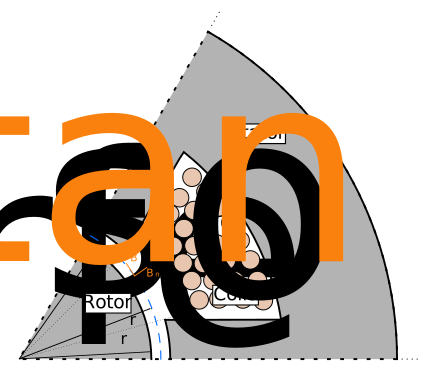
where \(\hat{A}\) is the electric loading, \(r_{si}\) is the inner stator bore radius, \(p\) is the number of pole pairs of the winding, and \(\delta\) is the airgap. The equation for \(B_\text{tan}\) is found to model the actual stator winding tangential fields fairly accurately, provided the iron is not saturated. The equation for \(B_{n}\) however varies greatly from actual radial fields in the airgap, especially as the airgap gets significantly large, even when the machine is operating well within the linear region of the magnetic steel. This analyzer improves upon the accuracy of the stator winding radial field equation by considering stator slot opening and motor airgap curvature effects. The assumed motor 2D-cross-section for this analyzer is shown below. The direction along which \(B_\text{n}\) and \(B_\text{tan}\) are taken to be positive has also been indicated in the figure. The analyzer can be extended to machines with permanent magnets on the rotor surface by considering an airgap of equivalent remanence.
The assumptions that have gone into the developement of this model are:
Electric steel has infinite permeability.
Both the rotor and stator have negligible eddy currents.
The rotor is non-salient.
This analyzer implements the model(s) provided in the following references:
Bergmann and A. Binder, “Design guidelines of bearingless PMSM with two separate poly-phase windings,” in XXII International Conference on Electrical Machines (ICEM), Lausanne, Switzerland, Sep. 2016`
Zhu and D. Howe, “Instantaneous magnetic field distribution in brushless permanent magnet DC motors. II. Armature-reaction field,” IEEE Trans. Magn., vol. 29, no. 1
1.2. Input from User
Users can choose between the following two problem classes to interface with this analyzer:
BFieldOuterStatorProblem1: Users provide winding factors and the problem class handles MMF calculation behind the scenes. It is assumed that the stator winding is excited with symmetric currents and that winding factors are provided considering the current space vector orientation.
BFieldOuterStatorProblem2: Users provide the MMF harmonics acting on the airgap directly as an input. This problem class allows users to consider assymetric or single phase excitation.
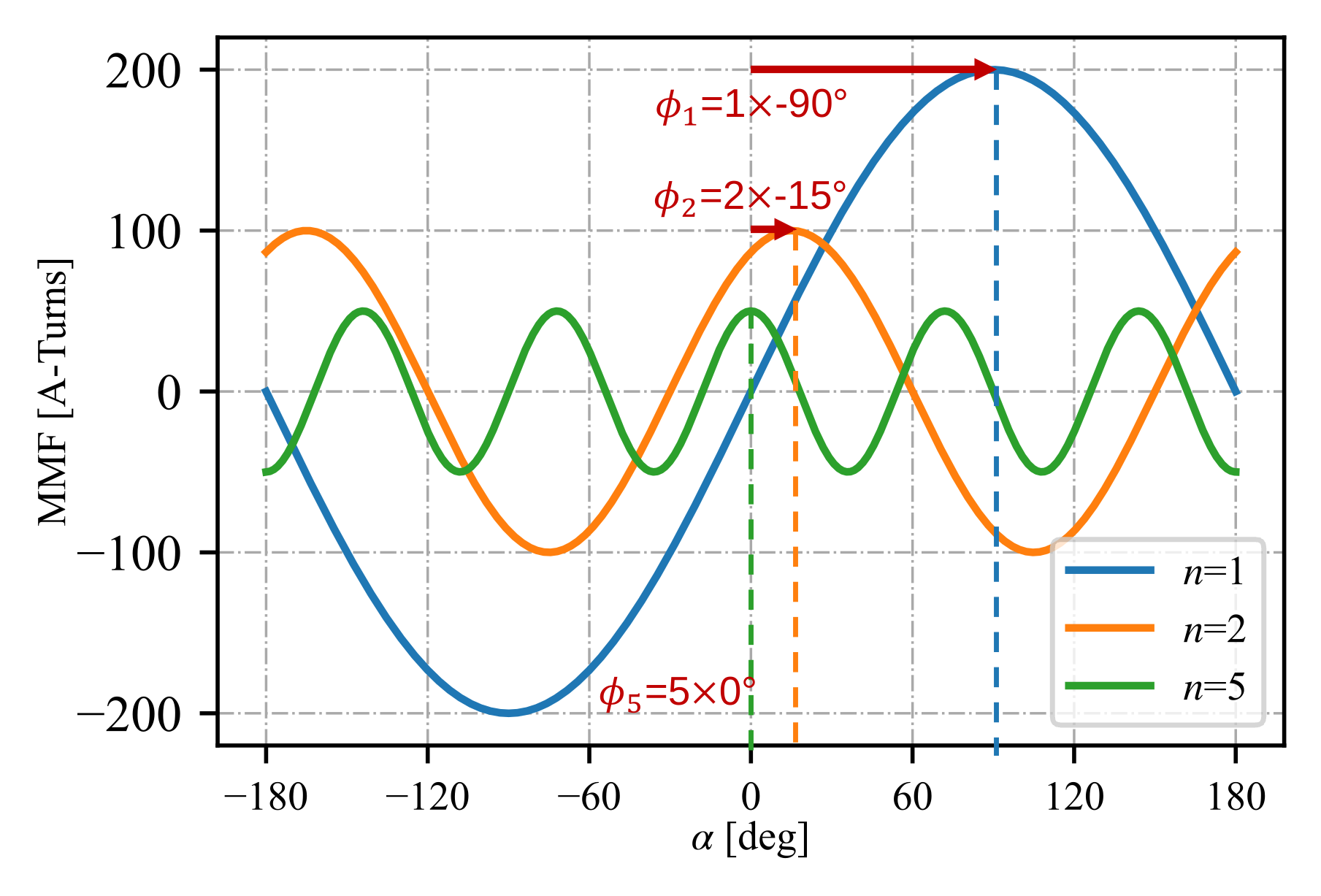
Both the winding factors and the MMF harmonics are to be provided as complex values representing the magnitude and phase of a Fourier Series. The phase must be provided cosidering the following cosine function: \(\hat{F}_n \cos(n\alpha + \phi_n)\), where \(\hat{F}_n\) is the magnitude of the MMF and \(\phi_n\) is the phase shift at harmonic \(n\).
A graphical representation of a stator winding MMF harmonics, along with the phase shift at each harmonic is provided in the figure below for clarification. The MMF input provided by the user to the analyzer to determine the fields originating from this winding should be [\(200 \times e^{-j\pi/3}\), \(100 \times e^{j\pi/6}\), \(50 \times e^{j0}\)] A-turns. The harmonics corresponding to each MMF component, i.e [1, 2, 5], must also be provided to the analyzer as a separate argument.
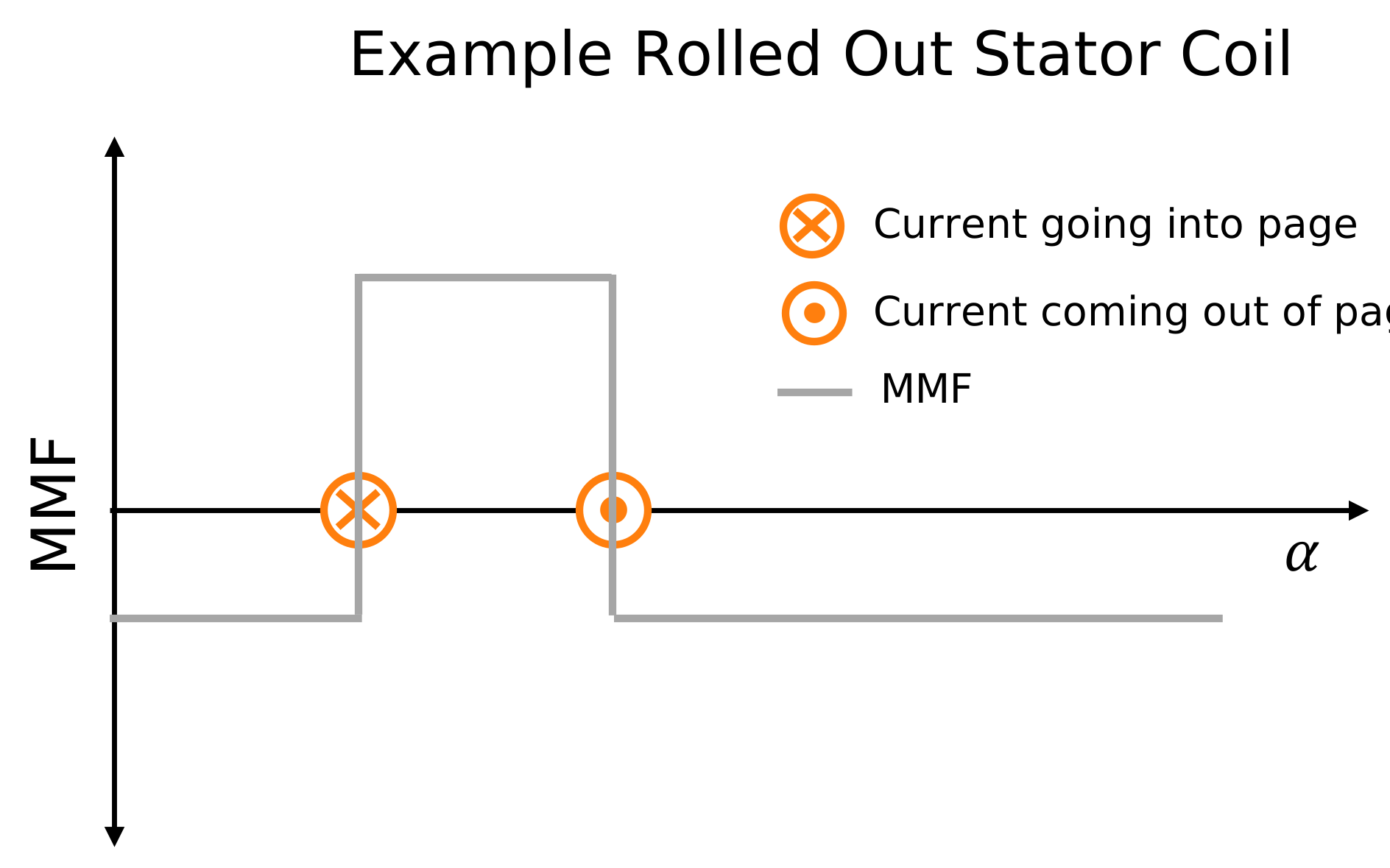
The figure below provides the convention used to determine the MMF waveform, and thereafter, the MMF harmonics.
The required input from the user along with the expected units for both problem classes are provided below:
Arguments |
Description |
Units |
|---|---|---|
m |
Number of phases |
|
zq |
Number of series turns per coil |
|
Nc |
Number of series coils per phase |
|
k_w |
Array of winding factor |
|
I_hat |
Peak Coil Current |
A |
n |
Array of harmonics corresponding to winding factor |
|
delta_e |
Effective airgap |
m |
r_si |
Inner bore radius of stator |
m |
r_rfe |
Outer radius of rotor iron |
m |
r |
Radius at which normal B-field is evaluated |
m |
alpha_so |
Stator slot opening |
radians |
Arguments |
Description |
Units |
|---|---|---|
MMF |
Array of MMF harmonics |
A-turns |
n |
Array of harmonics corresponding to MMF |
|
delta_e |
Effective airgap |
m |
r_si |
Inner bore radius of stator |
m |
r_rfe |
Outer radius of rotor iron |
m |
r |
Radius at which normal B-field is evaluated |
m |
alpha_so |
Stator slot opening |
radians |
Example code initializing the analyzer and problem1 is shown below:
import numpy as np
from matplotlib import pyplot as plt
from eMach.mach_eval.analyzers.electromagnetic.bfield_outer_stator import (
    BFieldOuterStatorAnalyzer,
    BFieldOuterStatorProblem1,
)

m = 3  # number of phases
zq = 20  # number of turns
Nc = 2  # number of coils per phase
k_w = np.array(
    [
        0.5 * np.exp(1j * np.pi / 3),
        0.866 * np.exp(-1j * np.pi / 5),
        0,
        0.866 * np.exp(-1j * 0),
        0.5 * np.exp(1j * np.pi / 6),
    ]
)  # winding factors
I_hat = 30  # peak current
n = np.array([1, 2, 3, 4, 5])  # harmonics of interest
delta_e = 0.002  # airgap
r_si = 0.025  # inner stator bore radius
r_rfe = r_si - delta_e  # rotor back iron outer radius
alpha_so = 0.1  # stator slot opening in radians

# define problem
stator_Bn_prob = BFieldOuterStatorProblem1(
    m=m,
    zq=zq,
    Nc=Nc,
    k_w=k_w,
    I_hat=I_hat,
    n=n,
    delta_e=delta_e,
    r_si=r_si,
    r_rfe=r_rfe,
    alpha_so=alpha_so,
)

# define analyzer
stator_B_ana = BFieldOuterStatorAnalyzer()
1.3. Output to User
The outer stator B field analyzer returns a OuterStatorBField object. This object has methods such as radial and tan which can be leverage to determine B fields across the airgap of the machine.
Example code using the analyzer to determine and plot \(B_\text{n}\) and \(B_\text{tan}\) at the inner bore of the stator is provide below (continuation from previous code block):
B = stator_B_ana.analyze(stator_Bn_prob)
r = r_si  # radius at which Bn field is required
# angles at which B field is required
alpha = np.arange(0, 2 * np.pi, 2 * np.pi / 360)

fig1 = plt.figure()
ax = plt.axes()
fig1.add_axes(ax)
# plot radial B fields
ax.plot(alpha, B.radial(alpha=alpha, r=r))
# plot tangential B fields
ax.plot(alpha, B.tan(alpha=alpha))

# sniff test for checking if fields are right. Below value should be very close to 0
tor = B.radial(alpha=alpha, r=r) * B.tan(alpha=alpha)
print(np.sum(tor))

ax.set_xlabel(r"$\alpha$ [deg]")
ax.set_ylabel("$B$ [T]")
ax.set_title("$B_n$ and $B_{tan}$ across airgap")
plt.legend(["$B_n$", "$B_{tan}$"], fontsize=8)
plt.grid(True, linewidth=0.5, color="#A9A9A9", linestyle="-.")
plt.show()
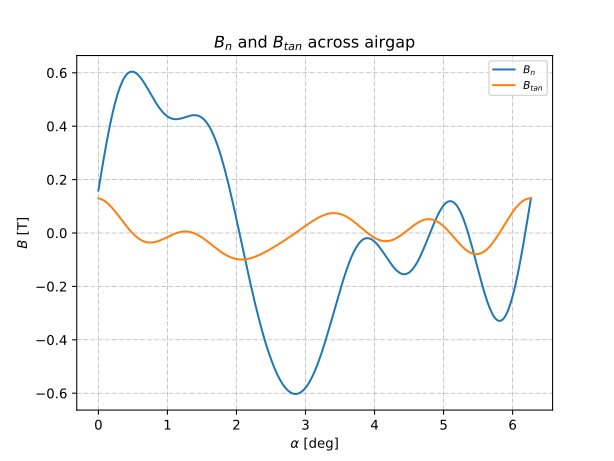
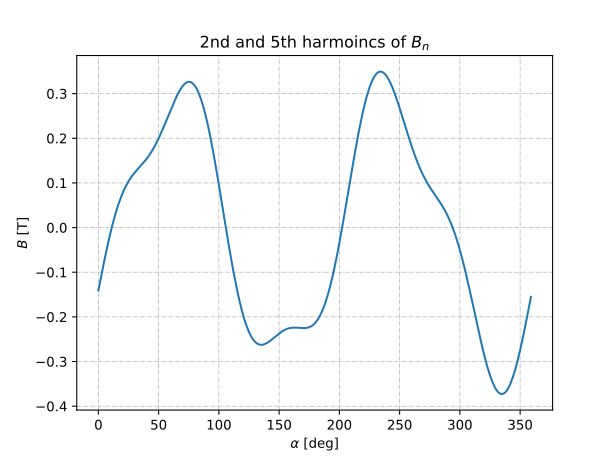
Both the B.radial() and the B.tan() methods can be passed with an optional harmonics argument if the users wishes to obtain fields of certain select harmonics alone. The below code snippet shows how the code can be modified to obtain the 2nd and 5th harmonics of the normal magnetic fields:
B = stator_B_ana.analyze(stator_Bn_prob)
r = r_si  # radius at which Bn field is required
# angles at which B field is required
alpha = np.arange(0, 2 * np.pi, 2 * np.pi / 360)

fig1 = plt.figure()
ax = plt.axes()
fig1.add_axes(ax)
# plot radial B fields
ax.plot(alpha * 180 / np.pi, B.radial(alpha=alpha, r=r, harmonics=np.array([2, 5])))

ax.set_xlabel(r"$\alpha$ [deg]")
ax.set_ylabel("$B$ [T]")
ax.set_title("2nd and 5th harmoincs of ${B}_n$")
plt.grid(True, linewidth=0.5, color="#A9A9A9", linestyle="-.")
plt.show()