6. SPM Rotor Structural Analyzer
This analyzer determines the stress in a surface-mounted permanent magnet (SPM) rotor with a retaining sleeve.
6.1. Model Background
The analyzer models the SPM rotor as a series of concentric cylinders, shown in the figure below. The rotor is assumed to have four regions of varying material: a shaft, rotor back iron, magnets, and a sleeve. The sleeve is designed with an undersized fit in order to provide the compressive force on the rotor. In addition to the compressive force from the sleeve, loading due to thermal expansion is also considered.

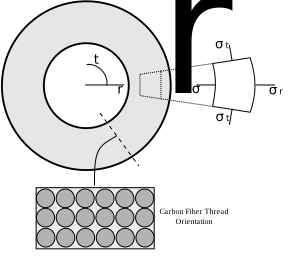
All materials except for the sleeve are assumed to be isotropic. The sleeve is modeled as anisotropic, which allows consideration of high performance materials such as carbon fiber. The analyzer implements the rotor model developed in this paper:
M Johnson, K. Hanson and E. L. Severson, “Normalized Analytical Model of Stresses in a Surface Mounted Permanent Magnet Rotor,” 2021 IEEE Energy Conversion Congress and Exposition (ECCE), 2021, pp. 3928-3935.
6.2. Inputs from User
The structural analyzer problem requires a material dictionary (mat_dict) and dimensions of the shaft, rotor core, magnet, and sleeve as defined in the diagrams above. The structural analyzer problem also takes in deltaT which represents the rotor temperature rise to account for thermal expansion. The deltaT values should be thought of as the temperature rise from rest, so if when the rotor is not in use it rests at 20C, then the temperature rise would be relative to that temperature.
Variable/key_value name |
Description |
Units |
|---|---|---|
shaft_material_density |
Shaft material density |
kg/m3 |
shaft_youngs_modulus |
Shaft youngs modulus |
Pa |
shaft_poission_ratio |
Shaft poission ratio |
|
alpha_sh |
Shaft temperature coefficient |
1/K |
core_material_density |
Rotor core material density |
kg/m3 |
core_youngs_modulus |
Rotor core youngs modulus |
Pa |
core_poission_ratio |
Rotor core poission ratio |
|
alpha_rc |
Rotor core temperature coefficient |
1/K |
magnet_material_density |
Magnet material density |
kg/m3 |
magnet_youngs_modulus |
Magnet youngs modulus |
Pa |
magnet_poission_ratio |
Magnet poission ratio |
|
alpha_pm |
Magnet temperature coefficient |
1/K |
sleeve_material_density |
Sleeve material density |
kg/m3 |
sleeve_youngs_th_direction |
Sleeve youngs thread direction |
Pa |
sleeve_youngs_p_direction |
Sleeve youngs plane direction |
Pa |
sleeve_poission_ratio_p |
Sleeve poission ratio plane |
|
sleeve_poission_ratio_tp |
Sleeve poission ratio thread x plane |
|
alpha_sl_t |
Temperature coefficient (Thread) |
1/K |
alpha_sl_r |
Temperature coefficient (plane) |
1/K |
sleeve_max_rad_stress |
Maximum radial stress of sleeve |
Pa |
sleeve_max_tan_stress |
Maximum tangential stress of sleeve |
Pa |
Variable/key_value name |
Description |
Units |
|---|---|---|
r_sh |
Shaft radius |
m |
d_m |
Magnet thickness |
m |
d_sl |
Sleeve thickness |
m |
delta_sl |
Sleeve undersize |
m |
r_ro |
Rotor outer radius |
m |
deltaT |
Rotor temperature rise |
K |
N |
Rotor speed |
RPM |
The following code demonstrates how to initialize the SPM_RotorStructuralProblem and SPM_RotorStructuralAnalyzer. The values used by the mat_dict are representative of typical values used by this analyzer assuming 1045 carbon steel for the shaft, M19 29-gauge laminated steel for the rotor core, N40 neodymium magnets, and carbon fiber for the sleeve.
import numpy as np
from matplotlib import pyplot as plt
import eMach.mach_eval.analyzers.mechanical.rotor_structural as sta
######################################################
# Creating the required Material Dictionary
######################################################
mat_dict = {
    'core_material_density': 7650,  # kg/m3
    'core_youngs_modulus': 185E9,  # Pa
    'core_poission_ratio': .3,
    'alpha_rc' : 1.2E-5,

    'magnet_material_density'    : 7450, # kg/m3
    'magnet_youngs_modulus'      : 160E9, # Pa
    'magnet_poission_ratio'      :.24,
    'alpha_pm'                   :5E-6,

    'sleeve_material_density'    : 1800, # kg/m3
    'sleeve_youngs_th_direction' : 125E9,  #Pa
    'sleeve_youngs_p_direction'  : 8.8E9,  #Pa
    'sleeve_poission_ratio_p'    :.015,
    'sleeve_poission_ratio_tp'   :.28,
    'alpha_sl_t'                :-4.7E-7,
    'alpha_sl_r'                :0.3E-6,

    'sleeve_max_tan_stress': 1950E6,  # Pa
    'sleeve_max_rad_stress': -100E6,  # Pa

    'shaft_material_density': 7870,  # kg/m3
    'shaft_youngs_modulus': 206E9,  # Pa
    'shaft_poission_ratio': .3,  # []
    'alpha_sh' : 1.2E-5
}
######################################################
#Setting the machine geometry and operating conditions
######################################################
r_sh = 5E-3 # [m]
d_m = 2E-3 # [m]
r_ro = 12.5E-3 # [m]
deltaT = 0 # [K]
N = 100E3 # [RPM]
d_sl=1E-3 # [m]
delta_sl=-2.4E-5 # [m]

######################################################
#Creating problem and analyzer class
######################################################
problem = sta.SPM_RotorStructuralProblem(r_sh, d_m, r_ro, d_sl, delta_sl, deltaT, N,mat_dict)
analyzer=sta.SPM_RotorStructuralAnalyzer()
6.2.1. Example with No Rotor Sleeve
To analyze a rotor with no sleeve, simple set d_sl, delta_sl, and deltaT to zero when creating the problem as shown in the following code:
######################################################
#Setting the machine geometry and operating conditions
######################################################
r_sh = 5E-3 # [m]
d_m = 2E-3 # [m]
r_ro = 12.5E-3 # [m]
deltaT = 0 # [K]
N = 50E3 # [RPM]
d_sl=0 # [m]
delta_sl=0 # [m]

######################################################
#Creating problem and analyzer class
######################################################
problem = sta.SPM_RotorStructuralProblem(r_sh, d_m, r_ro, d_sl, delta_sl, deltaT, N,mat_dict)
analyzer=sta.SPM_RotorStructuralAnalyzer()
6.3. Outputs to User
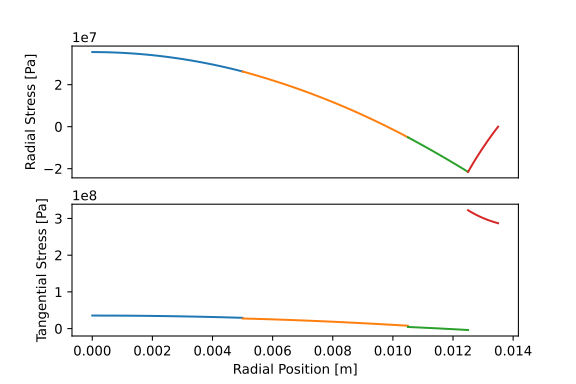
The SPM structural analyzer returns a list of sigma objects (referred to as sigmas). Each sigma object contains the analytic solution for radial and tangential stress in a single rotor components, as follows:
sigmas[0]: Shaftsigmas[1]: Rotor Coresigmas[2]: Magnetssigmas[3]: Sleeve
The user can obtain the stress (in units of Pa) at any radius in a rotor component using the sigma.radial() and sigma.tangential() methods. For example, sigmas[2].radial(r_ro) would return the radial stress at the outer edge of the magnets (radius of r_ro in units of m), and sigmas[2].tangential(r_ro) would return the tangential stress. If the user attempts to pass a radius which is outside of the range of the rotor component, then the sigma object will raise a ValueError. Note that the sigma objects determine the stress by solving equation (4) in the supporting paper.
Example code to calculate the stress distribution in the rotor:
######################################################
#Analyzing Problem
######################################################
sigmas=analyzer.analyze(problem)

######################################################
#Creating vectors of radius used for plotting
######################################################
r_vect_sh=np.linspace(r_sh/10000,r_sh,100)
r_vect_rc=np.linspace(r_sh,r_ro-d_m,100)
r_vect_pm=np.linspace(r_ro-d_m,r_ro,100)
r_vect_sl=np.linspace(r_ro,r_ro+d_sl,100)

######################################################
#Plotting Stress distribution in rotor
######################################################
fig,ax=plt.subplots(2,1)
ax[0].plot(r_vect_sh,sigmas[0].radial(r_vect_sh))
ax[0].plot(r_vect_rc,sigmas[1].radial(r_vect_rc))
ax[0].plot(r_vect_pm,sigmas[2].radial(r_vect_pm))
ax[0].plot(r_vect_sl,sigmas[3].radial(r_vect_sl))
ax[0].set_xticks([])
ax[0].set_ylabel('Radial Stress [Pa]')
ax[1].plot(r_vect_sh,sigmas[0].tangential(r_vect_sh))
ax[1].plot(r_vect_rc,sigmas[1].tangential(r_vect_rc))
ax[1].plot(r_vect_pm,sigmas[2].tangential(r_vect_pm))
ax[1].plot(r_vect_sl,sigmas[3].tangential(r_vect_sl))
ax[1].set_ylabel('Tangential Stress [Pa]')
ax[1].set_xlabel('Radial Position [m]')
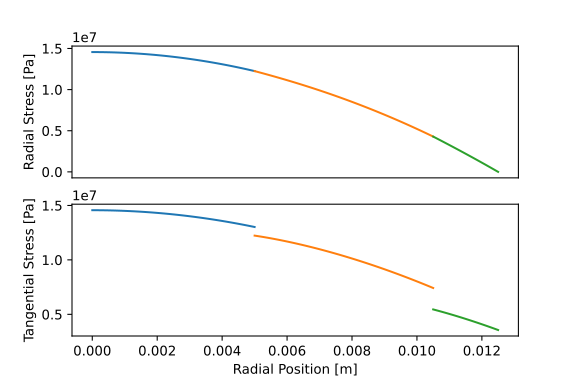
6.3.1. Example with No Rotor Sleeve
The following code will calculate the stress distribution for a rotor which is not utilizing a rotor sleeve:
######################################################
#Analyzing Problem
######################################################
sigmas=analyzer.analyze(problem)

######################################################
#Creating vectors of radius used for plotting
######################################################
r_vect_sh=np.linspace(r_sh/10000,r_sh,100)
r_vect_rc=np.linspace(r_sh,r_ro-d_m,100)
r_vect_pm=np.linspace(r_ro-d_m,r_ro,100)
r_vect_sl=np.linspace(r_ro,r_ro+d_sl,100)

######################################################
#Plotting Stress distribution in rotor
######################################################
fig,ax=plt.subplots(2,1)
ax[0].plot(r_vect_sh,sigmas[0].radial(r_vect_sh))
ax[0].plot(r_vect_rc,sigmas[1].radial(r_vect_rc))
ax[0].plot(r_vect_pm,sigmas[2].radial(r_vect_pm))
ax[0].set_xticks([])
ax[0].set_ylabel('Radial Stress [Pa]')
ax[1].plot(r_vect_sh,sigmas[0].tangential(r_vect_sh))
ax[1].plot(r_vect_rc,sigmas[1].tangential(r_vect_rc))
ax[1].plot(r_vect_pm,sigmas[2].tangential(r_vect_pm))
ax[1].set_ylabel('Tangential Stress [Pa]')
ax[1].set_xlabel('Radial Position [m]')