4. Windage Loss Analyzer
This analyzer determines windage loss in a rotating machine with an inner rotor.
4.1. Model Background
The analyzer assumes the simple motor structure shown below. This consists of a rotor inside of a stator and a forced axial airflow in the airgap of velocity uz.
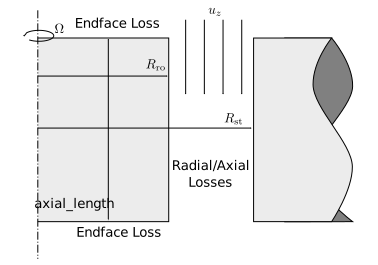
The following losses occur in this system:
Radial Losses: Losses on the radial airgap surfaces due to rotation.
Endface Losses: Losses on the axial surfaces of the shaft due to rotation.
Axial Losses: Losses on the radial airgap surfaces due to axial airflow through the airgap.
This analyzer determines the windage losses by implementing the model presented in the following papers:
An, A. Binder and C. R. Sabirin, “Loss measurement of a 30 kW high speed permanent magnet synchronous machine with active magnetic bearings,” 2013 International Conference on Electrical Machines and Systems (ICEMS), 2013, pp. 905-910.
Riemer, M. Leßmann and K. Hameyer, “Rotor design of a high-speed Permanent Magnet Synchronous Machine rating 100,000 rpm at 10kW,” 2010 IEEE Energy Conversion Congress and Exposition, Atlanta, GA, 2010, pp. 3978-3985.
4.2. Inputs from User
The following inputs are required to create a WindageLossProblem object (with dimensions defined in the figure above):
Variable/key_value name |
Description |
Units |
|---|---|---|
Omega |
Rotational Speed |
rad/s |
R_ro |
Outer rotor radius |
m |
axial_length |
Axial length |
m |
R_st |
Inner Stator Radius |
m |
u_z |
Axial airflow speed |
m/s |
T_air |
Air temperature |
C |
Example code initializing the windage loss analyzer and problem:
import numpy as np
import eMach.mach_eval.analyzers.mechanical.windage_loss as wla
from matplotlib import pyplot as plt

Omega=1000
R_ro=0.1
axial_length=0.05
R_st=0.105
u_z=0.01
T_air=25

problem=wla.WindageLossProblem(Omega,R_ro,axial_length,R_st,u_z,T_air)
ana=wla.WindageLossAnalyzer
4.3. Outputs to User
The windage analyzer returns a list of windage losses in Watts in the following order:
windage_loss_radialwindage_loss_endface(The endface losses are split evenly between the two rotor axial surfaces)windage_loss_axial
The total windage loss is the sum of all these losses.
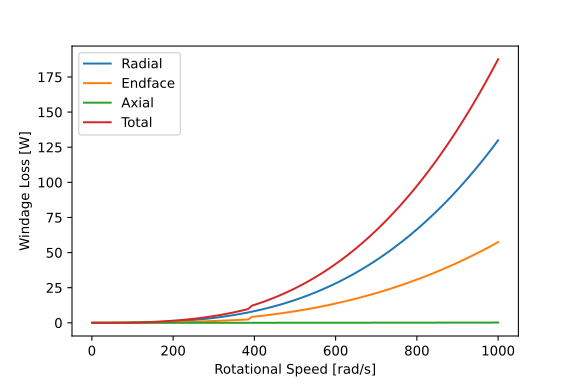
Example code using the windage loss analyzer to determine losses as over a range of rotational speed Omega and plotting the results.
results=ana.analyze(problem)
print(results)

Omega_vect=np.linspace(1,1000,100)
loss_vect=np.zeros([3,100])
total_loss_vect=np.zeros_like(Omega_vect)
for ind,Omega in enumerate(Omega_vect):
    problem=wla.WindageLossProblem(Omega,R_ro,axial_length,R_st,u_z,T_air)
    [windage_loss_radial,windage_loss_endface,windage_loss_axial]=ana.analyze(problem)
    loss_vect[:,ind]=[windage_loss_radial,windage_loss_endface,windage_loss_axial]
    total_loss_vect[ind]=sum([windage_loss_radial,windage_loss_endface,windage_loss_axial])
fig,ax=plt.subplots(1,1)
ax.plot(Omega_vect,loss_vect.T)
ax.plot(Omega_vect,total_loss_vect)
ax.legend(['Radial','Endface','Axial','Total'])
ax.set_xlabel('Rotational Speed [rad/s]')
ax.set_ylabel('Windage Loss [W]')
fig.savefig('WindageLossPlot.svg')