3. mach_opt Module Overview

The mach_opt module is designed to extend the user-defined problem definition prescribed by pygmo. In order for pygmo to run a multi-objective user-defined problem, the injected object must have three functions implemented: fitness, get_bounds, and get_nobj. The primary class of the mach_opt module is DesignProblem which implements these required functions. The flow of information between pygmo and the DesignProblem can be visualized in the following flowchart.
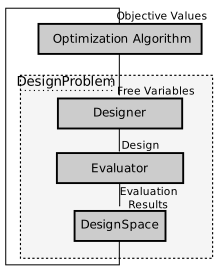
The DesignProblem class expects to receive several objects upon initialization that comply with defined protocols. (Note: Python’s protocol class capability was introduced in PEP 544.) These objects and their purpose are summarized as follows:
- Designer
The
Designerprotocol converts an input tuple into adesignobject.- Evaluator
The
Evaluatorprotocol evaluates thedesignobject for a set of criteria defined in theevaluatefunction.- DesignSpace
The
DesignSpaceprotocol handles converting the results of the evaluation into the objective variables.- DataHandler
Saves the design, evaluation results, and objective values so that optimization can be paused and resumed.
Additional details of each of these objects can be found in the code documentation. An example optimization of a rectangle using the mach_opt module can be found here.
3.1. Designer
The Designer protocol is used to convert the free variables from the optimization algorithm, into a design object. The design object, does not have any required function calls, and is used as a container for all the information regarding the design which is to be evaluated. In order to be considered a Designer class, the create_design function must be implemented using the following function signature.
@runtime_checkable
class Designer(Protocol):
        """Parent class for all designers

        """
        @abstractmethod
        def create_design(self, x: 'tuple') -> 'Design':
                raise NotImplementedError
3.2. Evaluator
The Evaluator protocol is used to define an evaluation procedure for the design object created by the Designer. In order for a class to fulfill the role of an Evaluator, the function call for the evaluate method must be defined as follows.
@runtime_checkable
class Evaluator(Protocol):
        """Parent class for all design evaluators"""
        @abstractmethod
        def evaluate(self, design: 'Design') -> Any:
                pass
3.3. DesignSpace
The DesignSpace protocol is used to convert the results of the design evaluation back into a form which is usable by the optimization algorithm and provides additional functions that the pygmo algorithm requires. The following function signatures must be implemented in order to be considered a DesignSpace.
class DesignSpace(Protocol):
        """Parent class for a optimization DesignSpace classes"""
        @abstractmethod
        def check_constraints(self, full_results) -> bool:
                raise NotImplementedError

        @abstractmethod
        def n_obj(self) -> int:
                return NotImplementedError

        @abstractmethod
        def get_objectives(self, valid_constraints, full_results) -> tuple:
                raise NotImplementedError

        @abstractmethod
        def bounds(self) -> tuple:
                raise NotImplementedError