9. Rotor Critical Speed Analyzer
This analyzer determines the first critical speed (first bending mode natural frequency) of a given cylindrical shaft.
9.1. Model Background
When designing high-speed machines, one crucial design aspect the designer must consider is the critical speed of the rotor. Under rotation, if the rotating frequency matches or is near its critical speed (resonance frequency/natural frequency), the rotor would undergo high amplitude vibration. These high amplitudes of vibration could cause permanent damage to the rotor and the machine. Hence, as a designer it is crucial to determine if the rotor design can operate at a targeted operating speed.
One method to estimate the critical speed of a rotor is by modeling it as an Euler-Bernoulli beam. By doing so, analytical equations can be used to estimate where the critical speed would occur for a given shaft design. The equation [1] used to estimate the critical speed is shown below:
where E is the Young’s Modulus of the shaft material, I is the area moment of inertia of the shaft, A is the cross-sectional area of the shaft and L is the length of the shaft. Note, \(\beta l\) is a numerical constant determined based on the boundary condition of the shaft under rotation. For a rotor shaft levitated in a bearingless machine, the boundary conditiion is typically considered as free-free, which has a numerical value of \(\beta l=4.7\) for first critical speed. For other boundary conditions, see Figure 1 below.
Note, the numerical subscript in \(\beta\) in figure below denotes the n-th resonance frequency/critical speed. (i.e. \(\beta_3l\) means 3rd critical speed.) For the purpose of designing a rotor shaft, it is recommended to stay below (or even better, 20 to 30% away) the first critical speed.
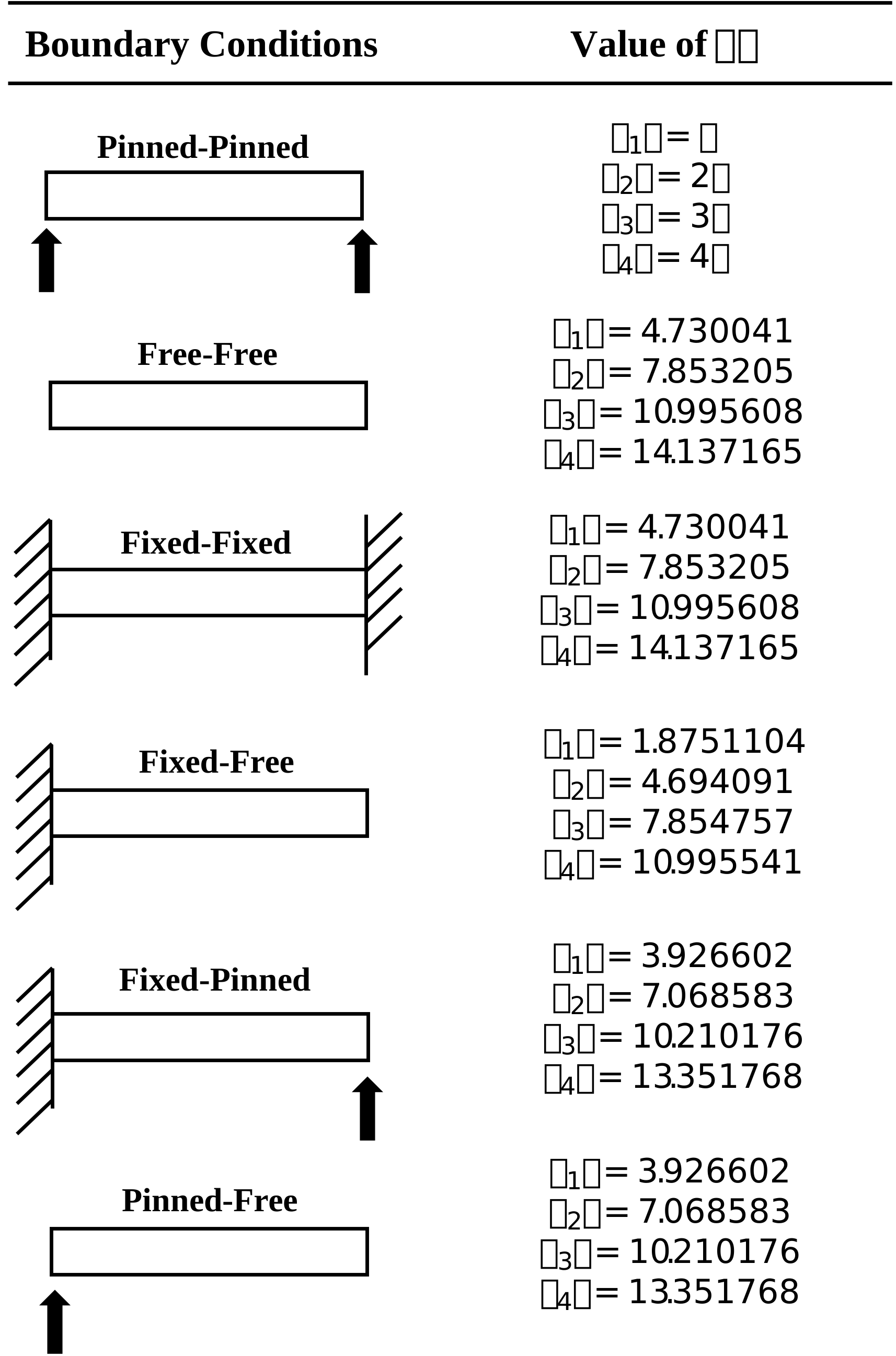
Figure 1. Value of \(\beta l\) under various boundary conditions, adopted from Figure 8.15 of [1]
9.1.1. Limitations
This analyzer assumes the cylindrical shaft as an Euler-Bernoulli beam.
This analyzer assumes a uniform area across the entire shaft length L.
This analyzer only considers the rotor shaft itself and not the attached components (ex. sleeve, magnets, etc.)
This analyzer should only be applied to slender shafts, where the length to diameter ratio is greater than 10, L/D > 10 [2].
9.1.2. Additional Notes
If bearings are considered, the system should be considered as a ‘Support-Supported’ system. Though, the result may deviate by up to 30%, as the bearing stiffness is not considered [2].
It is recommended that for a more accurate result, the user should perform an FEA modal analysis for the entire rotor assembly using a lumped-mass model approach to get a conservative estimate.
9.2. Input from User
In order to define the problem class, the user must specify the geometry of the shaft as well as the material properties for the material they intended to use. The inputs are summarized in the following tables:
Argument |
Description |
Units |
|---|---|---|
r_sh |
Shaft Radius |
m |
L |
Length of shaft |
m |
beta_l |
Boundary condition numerical constant |
|
material |
Shaft material dictionary |
For the material dictionary, the following key value pairs are needed:
Key-value pair name |
Description |
Units |
|---|---|---|
density |
Shaft material density |
kg/m3 |
youngs_modulus |
Shaft Young’s modulus |
Pa |
9.2.1. Example Code
The following example demonstrates how to initialize instances of RotorCriticalSpeedProblem and RotorCriticalSpeedAnalyzer.
Material properties for S45C medium carbon steel are used. The first code block initializes the material dictionary:
import eMach.mach_eval.analyzers.mechanical.rotor_critical_speed as rcs

 ######################################################
 # Create the required Shaft Material Dictionary
 ######################################################
 mat_dict = {
     # Material: S45C Steel
     'youngs_modulus':206E9, #Pa
     'density':7870, # kg/m3
     }
The following code then specifies the shaft geometry and numerical constant \(\beta_{fi}\).
######################################################
# Define rotor shaft geometry and numeric constants
######################################################
r_sh = 9E-3         # shaft radius
length = 164E-3     # shaft length
beta_l = 4.7       # free-free boundary condition numerical constant
This last code block creates a problem and analyzer object for this analyzer:
######################################################
# Define rotor critical speed problem and create instance of problem analyzer
######################################################
problem = RotorCritcalSpeedProblem(r_sh,length,beta_l,mat_dict)
analyzer = RotorCritcalSpeedAnalyzer(problem)
9.3. Output to User
This analyzer returns a RotorCritcalSpeedResult object containing the following attributes:
Attribute |
Description |
Units |
|---|---|---|
omega_n |
First bending mode critical speed |
rad/s |
Use the following code to run the example analysis:
result = analyzer.solve()
print(result.omega_n)
Running the example case returns the following:
18908.922312969735
This results indicates that the shaft design has an estimated critical speed of 18908.92 [rad/s], or 180,566 [RPM].