4. Force Data Analyzer
This analyzer determines performance characteristics in bearingless machines. Specifically, the analyzer returns the average of suspension force vector magnitude, the average of force vector’s x and y components, and error in force magnitude and angle in bearingless electric machines.
4.1. Model Background
Force vector is typically defined in terms of its magnitude \(F\) and angle \(\phi\) or in terms of x and y components \(F_x\) and \(F_y\). Using complex number notation, force vector is:
where \(\text{atan2}()\) is the four-quadrant inverse tangent, which determines the angle between positive x-axis and \(\vec{F}\).
Given arrays of \(F_x\) and \(F_y\) against time or rotor position (or arrays of \(F\) and \(\phi\)), the average parameters are calculated:
Using these parameters, error parameters are determined as follows:
4.2. Input from User
User is required to provide arrays of x and y components of the force vector to create a ProcessForceDataProblem object.
Arguments |
Description |
Units |
|---|---|---|
Fx |
Array of force vector x component |
Any (N, kN, etc.) |
Fy |
Array of force vector y component |
Same as Fx |
4.3. Output to User
Force data analyzer returns the following scalar values:
Arguments |
Description |
Units |
|---|---|---|
Fx_avg |
Average of force vector x component |
Same as input |
Fy_avg |
Average of force vector y component |
Same as input |
F_abs_avg |
Average of force vector magnitude |
Same as input |
Em |
Error in magnitude |
|
Ea |
Error in angle |
deg |
Example code using force data analyzer is provided below.
import numpy as np
import matplotlib.pyplot as plt
from eMach.mach_eval.analyzers.force_vector_data import (
    ProcessForceDataProblem,
    ProcessForceDataAnalyzer,
)

# define force vector and its x and y components (typically an output of FEA analysis)
theta = np.linspace(0, 2*np.pi,100)
force_vector = 15 * np.exp(1j * 0) + 3 * np.exp(1j * 2 * theta)
Fx = np.real(force_vector) # x-component of force vector
Fy = np.imag(force_vector) # y-component of force vector

# define problem
force_problem = ProcessForceDataProblem(Fx, Fy)
force_analyzer = ProcessForceDataAnalyzer()

# analyze the problem
Fx_avg, Fy_avg, F_abs_avg, Em, Ea = force_analyzer.analyze(force_problem)
F_ang_avg = np.arctan2(Fy_avg, Fx_avg) / np.pi * 180

# plot force components, force magnitude, and force angle vs. rotor position
color1=u'#1f77b4'
color2=u'#ff7f0e'
fig,ax=plt.subplots(3,1)

ax[0].plot(theta * 180 / np.pi, Fx, color=color1)
ax[0].plot(theta * 180 / np.pi, Fy, color=color2)
ax[0].plot(theta * 180 / np.pi, Fx_avg* np.ones(len(force_vector)), linestyle='--', color=color1)
ax[0].plot(theta * 180 / np.pi, Fy_avg* np.ones(len(force_vector)), linestyle='--', color=color2)
ax[0].set_xticks([])
ax[0].set_ylabel("Force components")
ax[0].set_xbound(0, 360)
ax[0].set_ybound(-5, 20)
ax[0].legend(['$F_x$','$F_y$'])

ax[1].plot(theta * 180 / np.pi, abs(force_vector))
ax[1].plot(theta * 180 / np.pi, F_abs_avg * np.ones(len(force_vector)), linestyle='--', color=color1)
ax[1].set_xticks([])
ax[1].set_ylabel("Force mag. [N]")
ax[1].set_xbound(0, 360)
ax[1].set_ybound(0, 20)

ax[2].plot(theta * 180 / np.pi, np.angle(force_vector) / np.pi * 180)
ax[2].plot(theta * 180 / np.pi, F_ang_avg * np.ones(len(force_vector)), linestyle='--', color=color1)
ax[2].set_ylabel("Force angle [deg]")
ax[2].set_xbound(0, 360)
ax[2].set_ybound(-60, 60)
ax[2].set_xticks(np.linspace(0, 360, 7))
ax[2].set_xlabel("Rotor angular position [deg]")

plt.show()
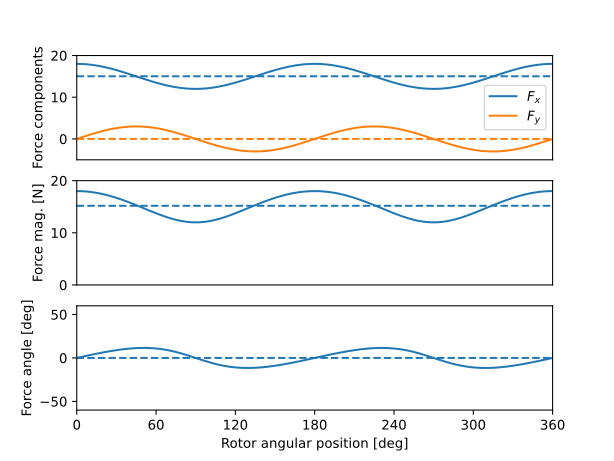
This code block defines force vector as a function of rotor position and uses force data analyzer to calculate the average force values and error in magnitude and angle. After running this example code, we expect to get Fx_avg = 15 N, Fy_avg = 0 N, F_abs_avg = 15 N, Em = 0.2 (20%), and Ea = 11.5 deg. The following plot is created, which shows force magnitudes and angles with their average values: