7. Winding Factors Analyzer
This analyzer determines the winding factors of a stator and winding layout for application in calculations of airgap harmonics.
7.1. Model Background
Winding factors \(\bar{k}_\text{w}\) are a way to characterize a winding’s ability to create or link flux and are instrumental in determining many aspects of electric machines, including harmonics present in the airgap field, electric loading, and shape of back-EMF. They can be thought of as a proportion of the geometric vector sum of the phasors of an individual back-EMF harmonic induced in coil sides of a phase winding over its algebraic sum, or mathematically using the following expression for a single phase:
where \(N\) is the total number of coil sides, \(e^{-jn\alpha_i}\) is the geometric representation of the phasor of each slot, \(n\)
is the harmonic index, and \(i\) is the slot number of the stator. The winding factor for each \(n\) should be calculated separately. The sum of each
of these calculations will result in a table of winding factors, all of which must be considered when choosing a design winding layout. This analyzer adds the
ability to calculate a winding factor based only on a stator geometry and layout. The addition of this analyzer eliminates the need for hand calculations for
winding factors within the bfield_outer_stator analyzer.
For example, given the layouts in the figure below, winding factors can be calculated for each of the stator geometries.
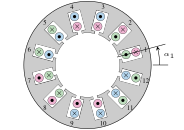
For this stator, the winding factor would be calculated using Phase U (blue) at slots 3-6 (-, out of page) and 9-12 (+, into page). The equation used for this calculation would look like the following:
The assumptions made going into the development of this model are:
Ideal slot fill factors
Ideal skew factors
7.2. Input from User
Users are utilizing a single problem class to interface with this analyzer. This class requires the user to provide the number of harmonics desired to be analyzed, the winding layout of the stator, and the location of the first slot. It is assumed that the stator winding is excited with symmetric currents and that slot fill and skew factors are ideal. The requirements can each be summarized below:
The number of harmonics being tested should be given as an array. The array can be either a specific array of each harmonic (1,2,5,etc.), or it can be a range of harmonics of length n (1,2,…,n).
The winding layout should also be given as an array. It should ONLY be provided for a single phase. In the case of this example, it will be using Phase U in the stator and winding layout provided. The number of columns in the array should be the number of slots in the stator. The number of rows in the array should be the number of layers in the stator. The top layer should be the first row and the bottom layer should be the bottom row. A “-1” should be indicated for a slot with windings going into the page, a “0” should be indicated for a slot with no windings present, and a “1” should be indicated for a slot with windings coming out of the page. Each winding layer should consume a single row of the winding array. Each slot should consume a single column of the winding array.
The location of the first slot should be indicated in radians from the +x axis. For example, a stator with the first slot at the x-axis will have an \(\alpha_\text{1}\) of 0 radians. The stator geometry in the machine depicted in the picture below (and stator cross-section above) has an \(\alpha_\text{1}\) of \(\frac{\pi}{12}\) radians.
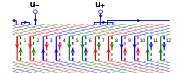
The required input from the user along with the expected units for the problem class can be summarized below:
Arguments |
Description |
Units |
|---|---|---|
harmonics_list |
“n” harmonics to be calculated |
|
winding_layout |
layout of stator winding for single phase |
|
alpha_1 |
location of first slot |
radians |
Example code initializing the analyzer and problem1 for the stator and winding layout shown is provided below:
import numpy as np
from eMach.mach_eval.analyzers.electromagnetic.winding_factors import (
    WindingFactorsProblem,
    WindingFactorsAnalyzer,
    )

n = np.array([1,2,3,4,5])
winding_layout = np.array([[0,0,0,0,-1,-1,0,0,0,0,1,1],[0,0,-1,-1,0,0,0,0,1,1,0,0]])
alpha_1 = np.pi/12
kw_prob = WindingFactorsProblem(n,winding_layout,alpha_1)

kw_ana = WindingFactorsAnalyzer()
7.3. Output to User
The winding factors analyzer returns a WindingFactors table. This table has structure that the winding factors are listed for each harmonics_list value. The
first winding factor represents the first harmonics_list value, the second winding factor represents the second value, and so on.
Example code using the analyzer to determine the winding factors for each harmonic is provided below (continuation from previous code block):
k_w = kw_ana.analyze(kw_prob)
The following complex winding factors should result from this stator for harmonics n = 1,2,3,4,5:
Harmonic Value |
Real Component |
Imaginary Component |
|---|---|---|
1 |
0.4183 |
j0.7244 |
2 |
-3.053e-16 |
-j4.163e-17 |
3 |
-8.327e-17 |
j9.714e-17 |
4 |
-3.469e-16 |
-j1.527e-16 |
5 |
-0.1121 |
j0.1941 |
7.4. Application to B Field Outer Stator Analyzer
In order to plot the current linkage and find the magnetic field of the inner bore of the stator, the winding factor analyzer can be applied to the B Field Outer Stator Analyzer by adding some code and making some alterations.
The definitions of the “harmonics of interest” and “winding factors” (variables n and k_w) can be changed and defined below. Note that for plotting the current
linkage, all of the harmonics should be considered. While in reality that is not possible, in practice a number on the scale of \(10^3\) should be used:
from eMach.mach_eval.analyzers.electromagnetic.winding_factors import (
WindingFactorsProblem,
WindingFactorsAnalyzer,
)

n = np.arange(1,1000)
winding_layout = np.array([[0,0,0,0,-1,-1,0,0,0,0,1,1],[0,0,-1,-1,0,0,0,0,1,1,0,0]])
alpha_1 = np.pi/12
kw_prob = WindingFactorsProblem(n,winding_layout,alpha_1)

kw_ana = WindingFactorsAnalyzer()

k_w = kw_ana.analyze(kw_prob)

kw_mag = abs(k_w)
kw_ang = np.angle(k_w)
This block is redefining the harmonics of interest, providing the winding layout and \(\alpha_\text{1}\), and actually calculating the winding factors instead
of having them directly provided. From here, the B Field Outer Stator Analyzer code should be entered as existing. After it is written, the following code should
be implemented to redefine the problem and plot the current linkage:
m = 3  # number of phases
zq = 20  # number of turns
Nc = 2  # number of coils per phase
I_hat = 30  # peak current
delta_e = 0.002  # airgap
r_si = 0.100  # inner stator bore radius
r_rfe = r_si - delta_e  # rotor back iron outer radius
alpha_so = 0.01  # stator slot opening in radians

# define problem
stator_Bn_prob = BFieldOuterStatorProblem1(
    m=m,
    zq=zq,
    Nc=Nc,
    k_w=k_w,
    I_hat=I_hat,
    n=n,
    delta_e=delta_e,
    r_si=r_si,
    r_rfe=r_rfe,
    alpha_so=alpha_so,
)

# define analyzer
stator_B_ana = BFieldOuterStatorAnalyzer()

B = stator_B_ana.analyze(stator_Bn_prob)
r = r_si  # radius at which Bn field is required
# angles at which B field is required
alpha = np.arange(0, 2 * np.pi, 2 * np.pi / 360)[:,None]

linkage = B.radial(alpha=alpha, r=r)*delta_e/(4*np.pi*10**(-7))
fig1 = plt.figure()
ax = plt.axes()
fig1.add_axes(ax)
# plot current linkage
ax.plot(alpha*180/np.pi, linkage, color='C0')

ax.set_xlabel(r"$\alpha$ [deg]")
ax.set_ylabel("$Current Linkage$ [A]")
ax.set_title("Current Linkage Diagram")
plt.grid(True, linewidth=0.5, color="#A9A9A9", linestyle="-.")
plt.show()
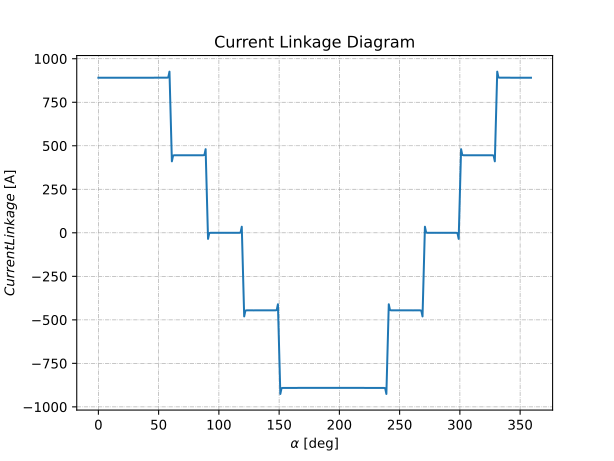
This code is taking the MMF function from the B Field Outer Stator Analyzer and calculating the current linkage directly. Within the B Field Outer Stator Analyzer,
this is then used to calculate the radial and tangential components of the B Field. The applied code should return the following plot for the current linkage of the
stator and winding layout depicted above:
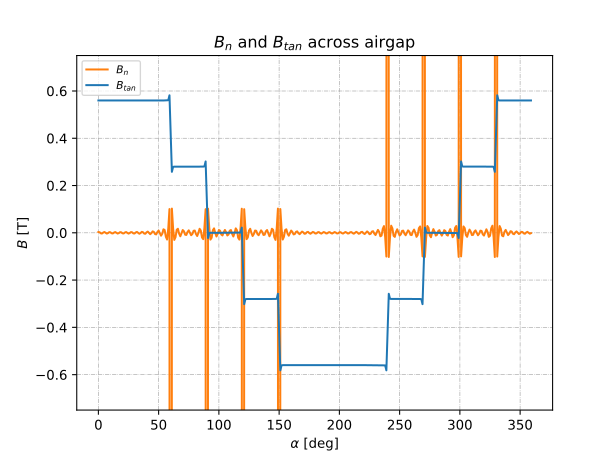
After plotting the current linkage, we can then use the data to plot the radial and tangential components of the magnetic field in the air gap. The B Field Outer Stator
Analyzer does this using the following code:
fig2 = plt.figure()
ax = plt.axes()
fig2.add_axes(ax)
# plot tangential B fields
ax.plot(alpha*180/np.pi, B.tan(alpha=alpha), color='C1')
# plot radial B fields
ax.plot(alpha*180/np.pi, B.radial(alpha=alpha, r=r), color='C0')

# sniff test for checking if fields are right. Below value should be very close to 0
tor = B.radial(alpha=alpha, r=r) * B.tan(alpha=alpha)
print(np.sum(tor))

ax.set_xlabel(r"$\alpha$ [deg]")
ax.set_ylabel("$B$ [T]")
ax.set_title("$B_n$ and $B_{tan}$ across airgap")
ax.set_ybound(-0.75, 0.75)
plt.legend(["$B_n$", "$B_{tan}$"], fontsize=8)
plt.grid(True, linewidth=0.5, color="#A9A9A9", linestyle="-.")
plt.show()
This code will result in the following plots for the magnetic field in the air gap: